How Old Do I Look? The Science Behind Facial Age Perception
From skin biology to AI detection — a deep dive into why we look the age we do, and what you can actually change about it

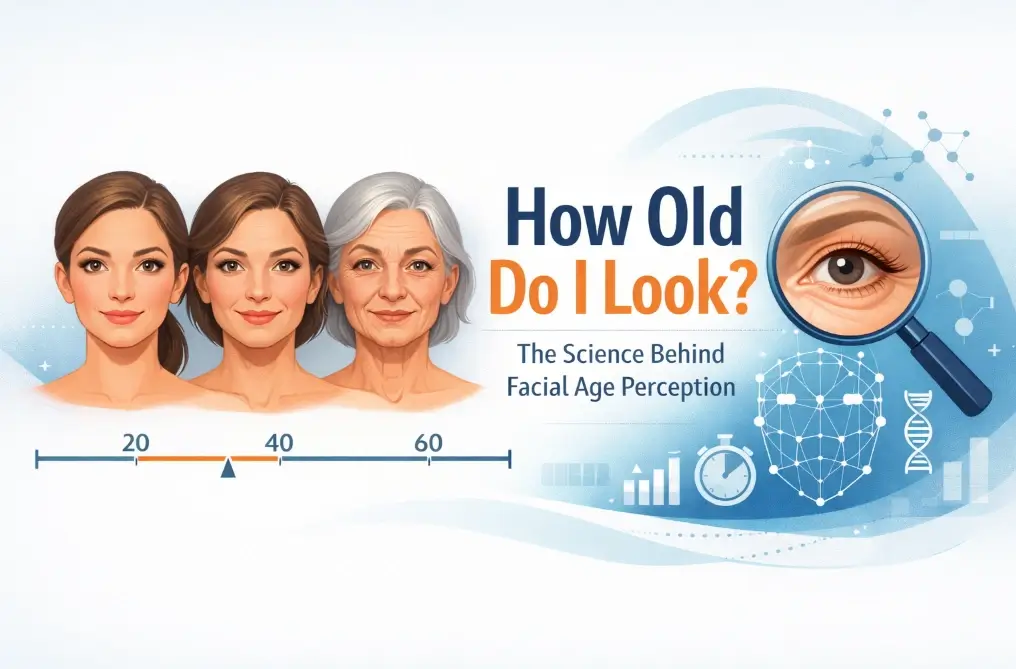
"How old do I look?" It is one of those questions most of us have asked at some point — in front of a mirror, after a rough week, or after uploading a photo and being genuinely surprised by the result. The answer is rarely just a number. It is the product of biology, lifestyle, light, and even the mood on your face. I have spent years writing about the intersection of technology and wellness, and the science of perceived age is one of the most fascinating — and practically useful — areas I have come across. This guide pulls together the latest research so you can understand exactly what is happening when someone looks at your face and makes an age judgment, and what you can realistically do about it.
The Neuroscience of Age Perception
The human brain is remarkably fast at estimating age. Neuroscience research shows we form an age impression within milliseconds of seeing a face — long before conscious thought kicks in. The brain integrates dozens of visual cues simultaneously: skin texture, facial volume, hair color, posture, and even the direction of facial expressions (upward versus downward).
This process is not purely objective. It is shaped by cognitive biases, cultural standards, and personal experience. A face that reminds you of someone you know can skew your estimate by several years. Familiarity with certain age cohorts — say, if you work with a lot of people in their 50s — recalibrates your internal reference point.
What this means practically: your apparent age is not a fixed number. It is a perception that shifts depending on who is looking, under what conditions, and in what context. That is both humbling and empowering.
Did You Know?
Studies show the brain can estimate a person's age within a few seconds by combining multiple facial features into a single judgment — a process that happens largely below the level of conscious awareness. — see the Wikipedia overview of photoaging for a solid primer on the biology.
Key Facial Signals That Reveal Your Age
Not all facial features carry equal weight in age perception. Research consistently identifies a hierarchy of cues:
1Skin Texture and Quality
The single strongest age signal. Fine lines, deeper wrinkles around the eyes and nasolabial folds, enlarged pores, and reduced luminosity all read as age markers. Conversely, smooth, even-toned skin with subtle reflectivity signals youth. Uneven pigmentation — sunspots, melasma, redness — amplifies perceived age even when wrinkles are minimal.
2Eye Area
The eyes are the focal point of age judgment. Crow's feet, under-eye hollowing, drooping eyelids, and reduced brightness in the iris all contribute significantly. Bright, well-defined eyes consistently read as younger.
3Facial Volume and Bone Structure
As we age, fat pads in the face shift and diminish, and bone density decreases. This creates a more angular, hollow appearance. Fuller cheeks and a defined but soft jawline are associated with youth.
4Hair Color and Density
Gray coverage, hair density, and hairline shape are powerful age cues. A fuller crown and softer hairline read younger; sparse density or a receding hairline adds perceived years.
5Facial Expression and Posture
Upward facial expressions — a genuine smile, lifted brows — consistently register as younger. Downward expressions and poor posture signal older age. This is one of the few cues you can change instantly.
| Facial Signal | Impact on Perceived Age | Modifiable? |
|---|---|---|
| Skin texture & wrinkles | Very High | Partially (SPF, retinoids, lifestyle) |
| Eye area (crow's feet, hollowing) | High | Partially (sleep, hydration, skincare) |
| Facial volume & bone structure | High | Partially (diet, exercise, weight) |
| Hair color & density | Medium–High | Yes (color, styling, treatments) |
| Facial expression & posture | Medium | Yes (immediate) |
| Skin tone evenness | Medium | Yes (SPF, vitamin C, niacinamide) |
Perceived Age vs. Biological Age — Why It Matters More Than You Think
Most people assume perceived age is purely cosmetic — a matter of vanity. The research says otherwise. A landmark cohort study published in the BMJ followed twins and found that perceived age was significantly associated with survival, even after adjusting for chronological age, sex, and health status. People who looked older than their years had measurably higher mortality risk.
A systematic review in Aesthetic Plastic Surgery found that older-looking individuals faced a 6–51% increase in mortality risk compared to controls (HR 1.06–1.51, p < 0.05). The mechanism is not fully understood, but perceived age likely reflects underlying biological aging processes — cellular senescence, oxidative stress, and cumulative environmental damage — that also affect organ health.
Perhaps most importantly for those of us who worry about genetics: a twin study found that approximately 40% of the variation in perceived age is due to non-genetic, modifiable factors. That is a significant window for intervention.
The Health Connection
Looking older than your chronological age is associated with a 6–51% higher mortality risk in peer-reviewed research. Perceived age is not just about appearance — it reflects real biological aging processes.
40%
of perceived age variation is due to modifiable lifestyle factors
6–51%
higher mortality risk in people who look older than their age
2.3 yrs
younger appearance gained per decade in Danish longevity studies
Factors That Make You Look Older
Understanding what accelerates perceived aging is the first step to addressing it. The research is clear on the major culprits:
| Factor | Estimated Aging Effect | Reversible? |
|---|---|---|
| Unprotected UV exposure | Up to 90% of visible aging | Partially — prevention is key |
| Smoking (20 cigarettes/day) | ~10 years of additional aging | Stopping halts further damage |
| Chronic sleep deprivation | Rated 2–4 years older by observers | Yes — improves within weeks |
| High-sugar diet | Accelerates collagen stiffening via glycation | Partially — dietary changes help |
| Chronic stress | Accelerates telomere shortening | Partially — stress management helps |
Factors That Help You Look Younger
The good news: the same research that identifies what ages us also points clearly to what preserves a youthful appearance. Some of this is genetic, but a meaningful portion is within your control.
Genetics — The Foundation
Genetics account for roughly 60% of perceived age variation. People born with genes that promote efficient collagen production, thicker dermis, and stronger antioxidant systems naturally maintain a younger appearance longer. Facial fat distribution — rounder faces tend to read younger due to the 'baby face' effect — is also largely inherited. You cannot change your genes, but knowing your baseline helps you calibrate realistic expectations.
Evidence-Based Lifestyle Interventions
- Daily broad-spectrum SPF — The single highest-ROI anti-aging intervention. SPF 30+ applied daily prevents the UV damage that causes up to 90% of visible aging. A randomized controlled trial published in the Annals of Internal Medicine found that daily sunscreen use measurably slowed skin aging over a 4.5-year period.
- Retinoids (vitamin A derivatives) — The most evidence-backed topical anti-aging ingredient. Retinoids stimulate collagen production, accelerate cell turnover, and reduce the appearance of fine lines. Both prescription tretinoin and over-the-counter retinol have strong clinical evidence.
- Consistent sleep (7–9 hours) — During deep sleep, growth hormone is released and skin repair processes peak. Consistent quality sleep is one of the most underrated anti-aging interventions — and one of the most accessible.
- Antioxidant-rich diet — Vitamins C and E, polyphenols from berries and green tea, and omega-3 fatty acids from fish all support skin structure and reduce oxidative stress. The Mediterranean diet pattern has the strongest evidence base for skin health.
- Regular exercise — Exercise improves circulation, delivering oxygen and nutrients to skin cells. Research has also shown that regular aerobic exercise can reverse some markers of skin aging at the cellular level, including mitochondrial function in skin cells.
Research Spotlight
A randomized controlled trial published in the Annals of Internal Medicine (via NIH PubMed Central) found that participants who applied broad-spectrum sunscreen daily showed measurably less skin aging after 4.5 years compared to a discretionary-use group — one of the strongest real-world proofs that SPF works.
How AI Detects Your Apparent Age
When you upload a photo to an AI age detection tool and ask "how old do I look?", the system is doing something remarkably sophisticated in a matter of seconds. Here is what is actually happening:
1. Face Detection and Landmark Mapping
The AI first locates your face and maps 68 to 194 key facial landmarks — specific points at the corners of your eyes, along your jawline, around your mouth, and across your forehead. This creates a precise geometric map of your facial structure.
2. Feature Extraction via Convolutional Neural Networks
A deep learning model — typically a convolutional neural network (CNN) trained on millions of labeled facial images — extracts hundreds of features from your face. These include wrinkle depth, skin texture patterns, facial volume distribution, and subtle structural changes that correlate with age.
3. Age Prediction and Confidence Scoring
The extracted features are compared against the model's training data to generate an age prediction. Modern systems also output a confidence score. A 2024 study using LC-OCT imaging and deep learning achieved a mean absolute error of just 4.2 years, with a Pearson correlation coefficient of 0.937 — meaning the AI's predictions closely track actual age.
Important Note on AI Age Results
AI age detection predicts apparent age — how old you look — not your biological or chronological age. The two can differ significantly based on genetics, lifestyle, and photo conditions. A well-lit, front-facing photo in good resolution will always produce more accurate results than a poorly lit or angled shot.
4.2 yrs
Mean absolute error in 2024 deep learning study
0.937
Pearson correlation with actual age
<5 sec
Typical processing time
How to Look Younger in Photos
Whether you are testing an AI age tool or preparing a profile photo, these evidence-backed techniques make a measurable difference in how old you appear:
Use soft, diffused front lighting
Harsh overhead or side lighting creates deep shadows that emphasize wrinkles and hollows. Natural window light from the front is the most flattering — it fills in shadows and gives skin a luminous quality that reads as younger.
Shoot at eye level or slightly above
A camera positioned slightly above eye level defines the jawline, reduces the appearance of under-chin fullness, and creates a more youthful facial proportion. Shooting from below does the opposite.
Smile genuinely — it lifts everything
A genuine smile (Duchenne smile, involving the eyes) lifts the midface, creates positive facial tension, and is consistently rated as younger-looking in perception studies. A forced or neutral expression can add perceived years.
Hydrate before important photos
Well-hydrated skin appears plumper and more luminous. Drinking adequate water in the 24 hours before a photo session and applying a good moisturizer beforehand makes a visible difference in skin texture.
Posture and confidence
Upright posture, a relaxed neck, and a confident bearing all contribute to a younger impression. Slouching compresses the neck and creates unflattering angles.
The Takeaway
"How old do I look?" is a question with a surprisingly complex answer. Your apparent age is shaped by genetics, decades of UV exposure, lifestyle choices, and even the angle of the camera. The science is clear that perceived age matters beyond vanity — it reflects real biological processes and has measurable health implications.
The most empowering finding from the research is that roughly 40% of perceived age variation is modifiable. Daily SPF, quality sleep, a diet rich in antioxidants, and not smoking are not just wellness clichés — they are the interventions with the strongest evidence base for looking and feeling younger.
AI age detection tools like ours give you an objective, instant read on how old you appear in a given photo. Use it as a fun data point, a way to test different photos, or a motivator for the lifestyle changes that actually move the needle.
Want to go deeper on the AI side of things? Our Complete AI Age Guesser Guide covers tool comparisons, accuracy benchmarks, and privacy considerations in detail.
Frequently Asked Questions
About the Author
Emily Chen
Emily Chen is a technology and wellness journalist with over eight years of experience covering artificial intelligence, dermatology research, and the science of aging. Her work has appeared in leading health and tech publications. She is passionate about translating complex research into practical, evidence-based insights for everyday readers.
References & Sources
- Christensen K, et al. (2009). Perceived age as clinically useful biomarker of ageing: cohort study. BMJ, 339, b5262.
- Guida JL, et al. (2022). Perceived Age as a Mortality and Comorbidity Predictor: A Systematic Review. Aesthetic Plastic Surgery.
- Flament F, et al. (2013). Effect of the sun on visible clinical signs of aging in Caucasian skin. Clinical, Cosmetic and Investigational Dermatology, 6, 221–232.
- Goodman GD, et al. (2019). Impact of Smoking and Alcohol Use on Facial Aging in Women. Journal of Clinical and Aesthetic Dermatology, 12(8), 28–39.
- Costin GE & Bhawan J. (2024). Evaluating facial dermis aging with LC-OCT and deep learning. ResearchGate.
- Rexbye H, et al. (2006). Influence of environmental factors on facial aging. Age and Ageing, 35(2), 110–115.
- Wikipedia contributors. Photoaging. Wikipedia, The Free Encyclopedia.
- Krutmann J, et al. (2017). The skin aging exposome. Journal of Dermatological Science, 85(3), 152–161.
Last updated: April 1, 2026